

The Extraordinary Example George Washington Set
And how it's commemorated at our public lands, waters, and parks

On the morning of December 15, 1799, the fledgling United States awoke to news that would send shockwaves through the insecure new nation: George Washington was dead.
America’s first president died the evening before, December 14, at Mount Vernon, the Virginia plantation that had been both his refuge and his burden. He was 67 years old, taken by a sudden illness after decades spent not just shaping a nation, but repeatedly sacrificing his own comfort, fortune, and power to ensure it would survive.
His death was mourned across the young republic with an intensity rarely repeated since, because Americans understood—almost certainly more clearly then than now—that Washington’s greatness was not only his victories or leadership, but his restraint.
His greatness—his immortality, to use a powerful word—lay in his self-control and an overwhelming sense of duty, rather than in a desire for self-enrichment or protecting his own assets.
If George Washington, for all the flaws that he undeniably had, had not been a patriot, the United States of America would not exist. It really is that simple.
Washington was, by any reasonable standard of his era, one of the wealthiest men in North America. He owned vast tracts of land across multiple colonies, commanded lucrative agricultural operations, and stood at the center of the Virginia gentry.
He could easily have remained at Mount Vernon as a prosperous planter, insulated from the chaos and danger of rebellion, and no one would have blamed him. Many planters did just that—and none of them are known now.
Instead, he walked away from financial security and social comfort to accept command of a ragged, unpaid, often starving Continental Army. He did so knowing full well that failure would mean not just personal ruin, but likely execution for treason.
For eight grinding years, Washington lived and traveled largely as his soldiers did.
During the night of Christmas Day, 1776—during a brutal snowstorm—he and his troops famously crossed the Delaware River and captured a thousand Hessian soldiers. He returned to Philadelphia, but, merely a week later, they crossed it again, attacking Trenton a second time, as well as Princeton.
The sites of the crossings are now known as Washington Crossing, Pennsylvania, and Washington Crossing, New Jersey. Both are at the end of the Lower Delaware National Wild and Scenic River, a unit managed by the National Park Service and the largest free-flowing public river in the eastern United States.
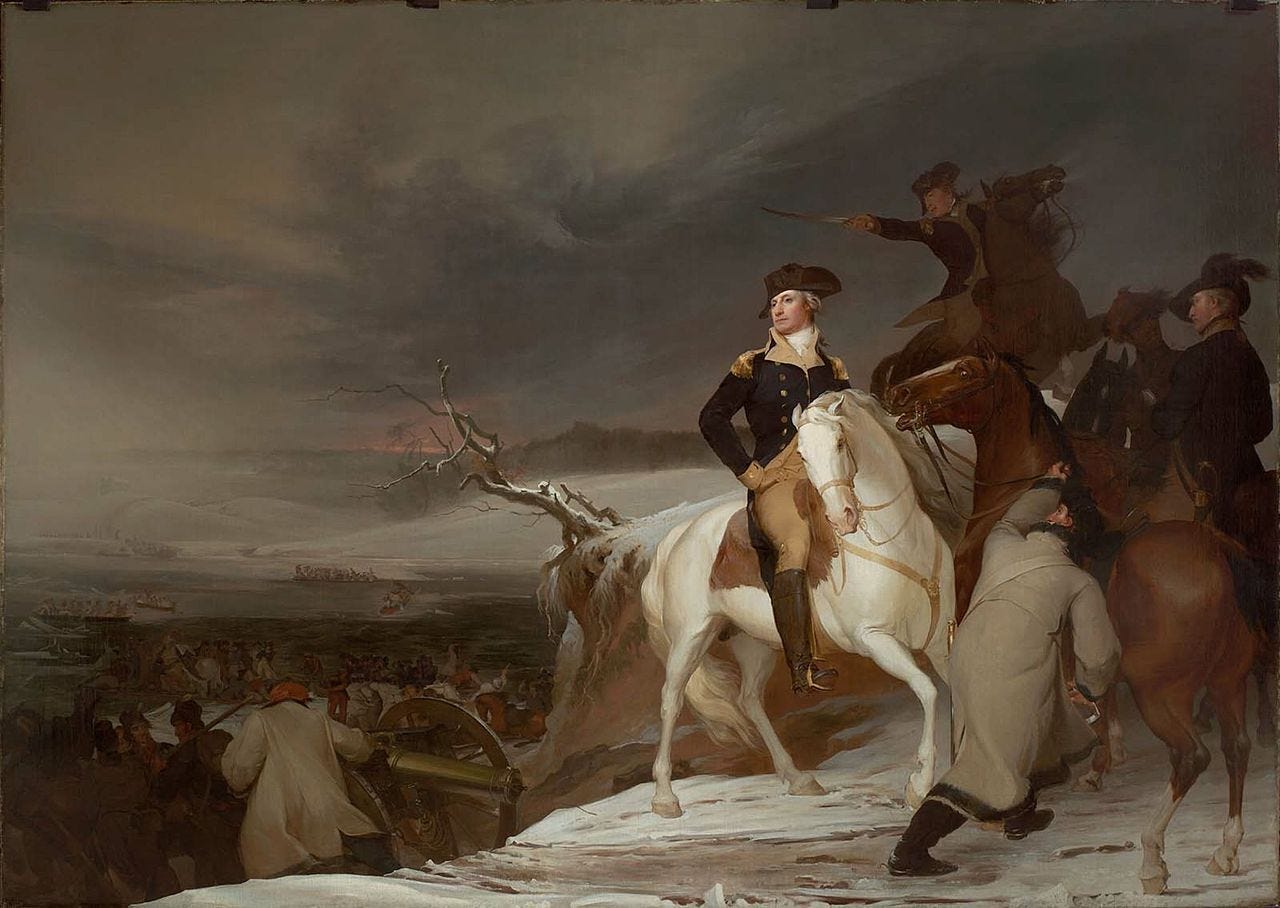
Washington and his army moved constantly, slept in tents and crude huts, endured shortages of food, clothing, and medicine.
Nowhere is Washington’s determination and discipline better preserved than at Valley Forge, today protected as Valley Forge National Historical Park. The site does not commemorate a decisive battle—it commemorates endurance.
During the winter of 1777–78, Washington’s army froze, starved, and got sick in makeshift encampments while Congress bickered and support faltered. Washington remained, though. He did not leave.
Instead of seeking comfort in his own mansion back in Virginia, he wrote desperate letters from the field, reorganized the army, absorbed criticism, and refused to abandon the cause.
This pattern repeated throughout Washington’s public life. After the war, he could have turned his historic military victories into political dominance or personal power. Instead, he resigned his commission and returned to Mount Vernon.
King George III was so impressed by this, he considered abdicating himself.
Yeah, I’ll gladly repeat that: Washington’s resignation from the Continental Army was such a powerful act that the British King George III—the very king Washington had fought—considered doing the same thing.
Washington later once again displayed his extraordinary restraint after two terms as president, voluntarily stepping away from authority that he could easily have clung to. There was, after all, no legal requirement for presidents to step down at all—he was the first one.
Washington did so anyway, fully aware of the precedent he was setting and emphasizing that he believed presidents should not hold office for life in his “Farewell Address” in 1796.
Today, Washington’s legacy is embedded across our public lands and waters, in places that emphasize service over spectacle.
The Delaware River embodies Washington’s determination and tactical talent. Valley Forge commemorates the human cost and sacrifice required for independence.
Colonial National Historical Park traces the political and military origins of the Revolution he held together, while also preserving the Yorktown Battlefield where Washington, along with French forces, ultimately defeated General Cornwallis and won American independence.
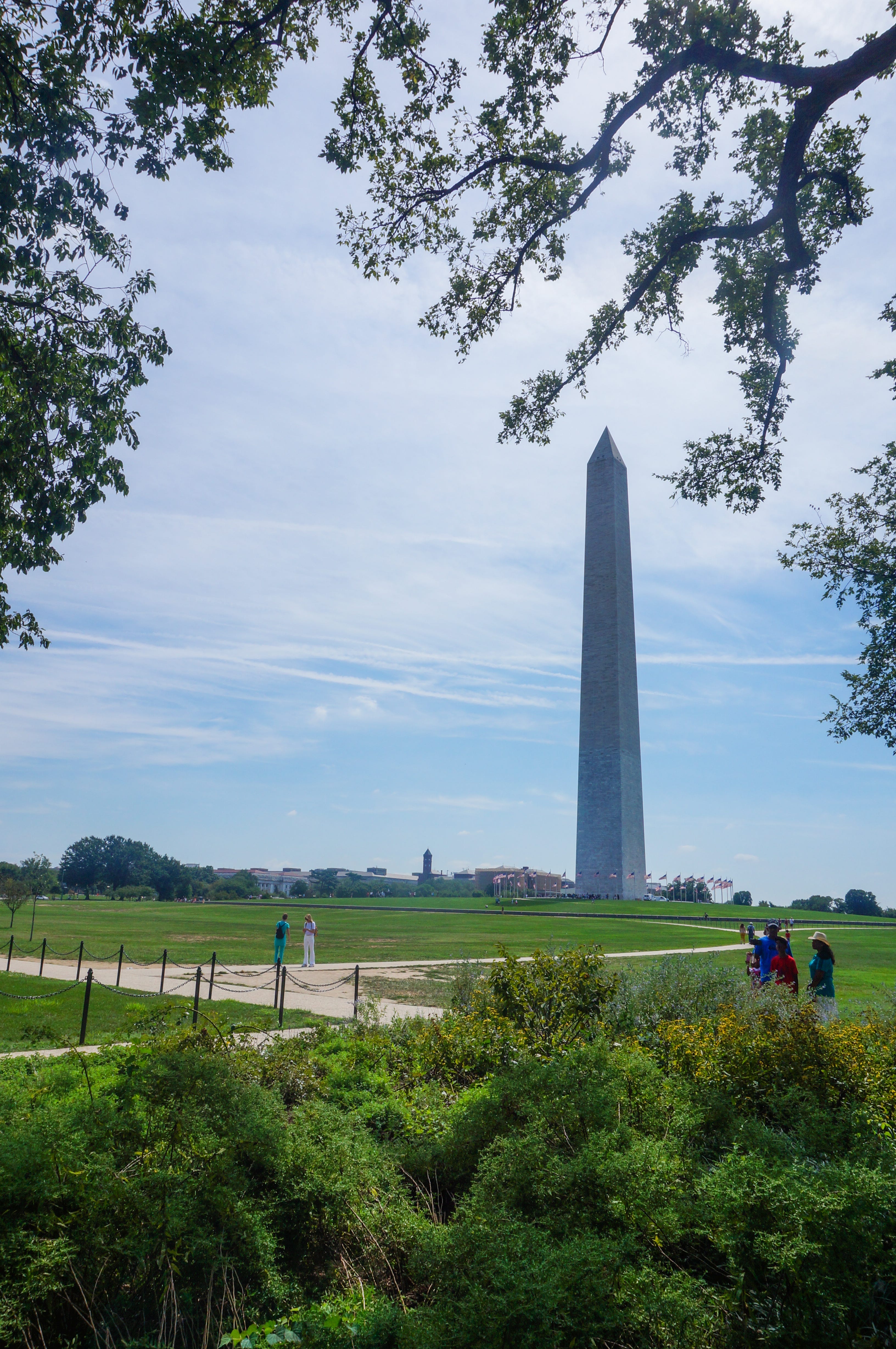
The Washington Monument on the National Mall—also administered by the National Park Service—rises not as a celebration of wealth or conquest, but as a stark, almost austere obelisk, intentionally devoid of ornaments or decorations.
Even Mount Vernon, while not a national park or federally managed site, functions as a place of reflection on the tension between Washington’s privilege and his choices, including the moral contradictions of slavery that complicate any honest assessment of his life.
What makes Washington’s story so powerful today is not that he was wealthy, but that he was willing to risk losing everything he had for an idea larger than himself.
He did not insulate himself from danger. He did not outsource sacrifice. He did not demand flattery as a condition of service. He lived among his troops, suffered the same defeats, and (mostly) accepted responsibility when things went wrong.
It’s difficult to imagine many modern billionaires or presidents making a comparable choice—walking away from immense personal wealth, exposing themselves to real physical hazards and hardships, and enduring years of deprivation for a cause with no guaranteed payoff whatsoever.
Contemporary power too often seeks insulation: private jets instead of muddy roads, fortified compounds instead of open camps, influence without accountability. Washington’s example exposes that contrast sharply.
His leadership was not performative—it was participatory. It was grounded in the belief that legitimacy comes from shared sacrifice.
And the American people loved him for it. They still do.
Americans put him on Mount Rushmore National Memorial—as controversial, though, as that sculpture may be.
In 1932, on the 200th anniversary of George Washington’s birthday, and while construction of Mount Rushmore was ongoing, the National Park Service officially opened George Washington Birthplace National Monument to the public.
Additionally, the tallest structure in the capital of United States that’s not a communications tower, the Washington Monument, was built in his honor.
The very capital itself was not named by him but after him.
Washington’s death marked the end of a mere man. But the public lands, waters, and parks that honor him continue to reflect an undeniable truth—as eroded as it may be right now—that the American idea was conceived not by those who protected their own wealth at all costs.
To the contrary, it was developed, defended, and ultimately achieved by those willing to risk and surrender it all, and live in tents in the wilderness.
All of these public places continue to commemorate that the country was not founded by men who demanded comfort and ego-feeding first, and principles second.
The United States was fought over and ultimately founded, quite literally, by individuals willing to trade luxury for responsibility.
As a closing note, I’d like to repeat that personal gain was the last thing on George Washington’s mind in the 1770s and 1780s.
It’s that willingness to sacrifice his own comforts, not to accumulate more wealth for his family—to literally risk death for his country, not to avoid having to go to war in the first place—to voluntarily give up the presidency, not to claim absolute power when he could’ve done so—that makes Washington the greatest president in U.S. history.
The nation was lucky it was him and no one else.
Remember this next year when we’ll all celebrate the United States of America’s 250th birthday.
Thanks for reading!
See you on our public lands and waters,
Bram
Hooray! A president to be proud of! Thank you for teaching the history of our country through this lens! And a bonus painting!!